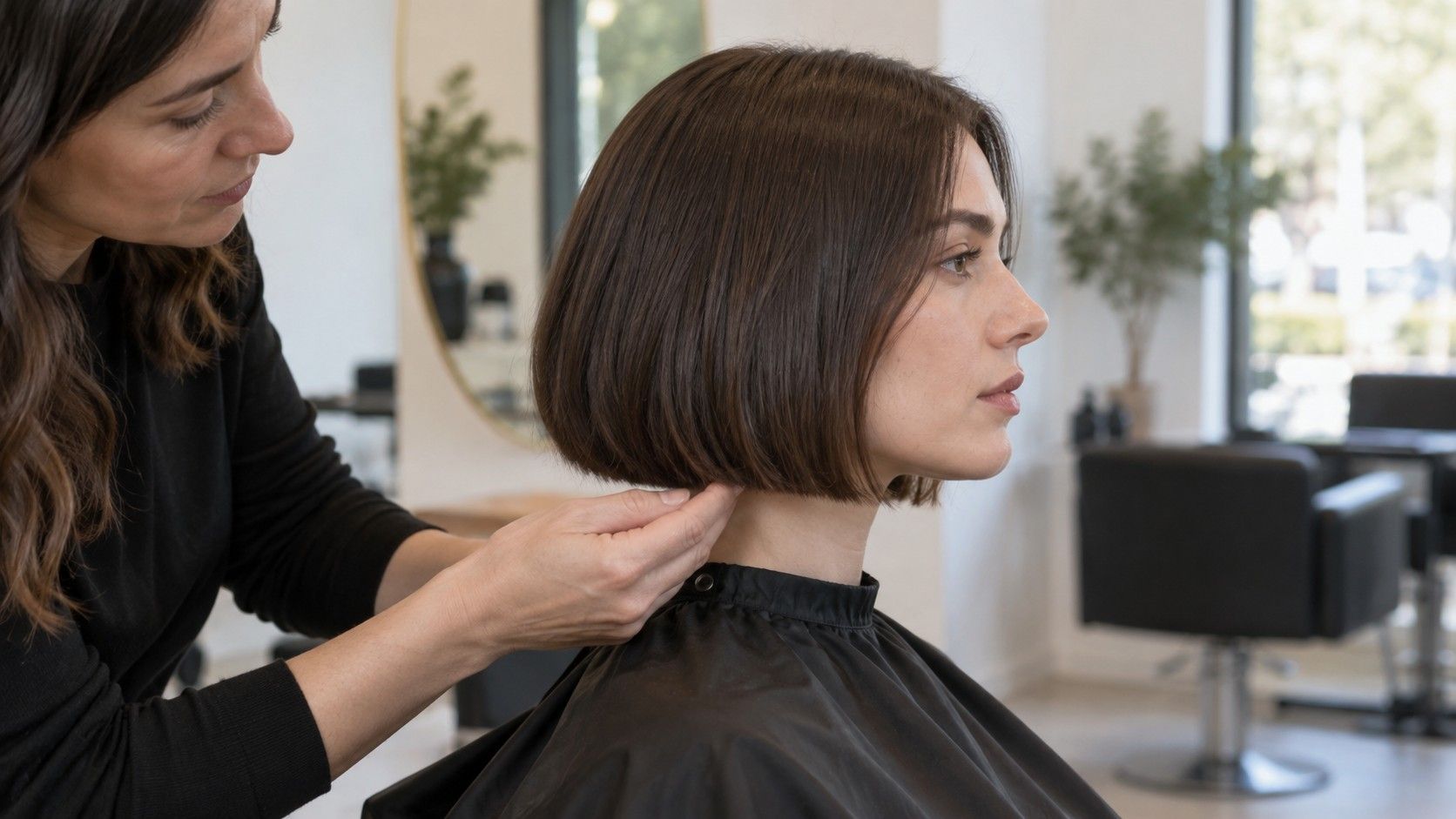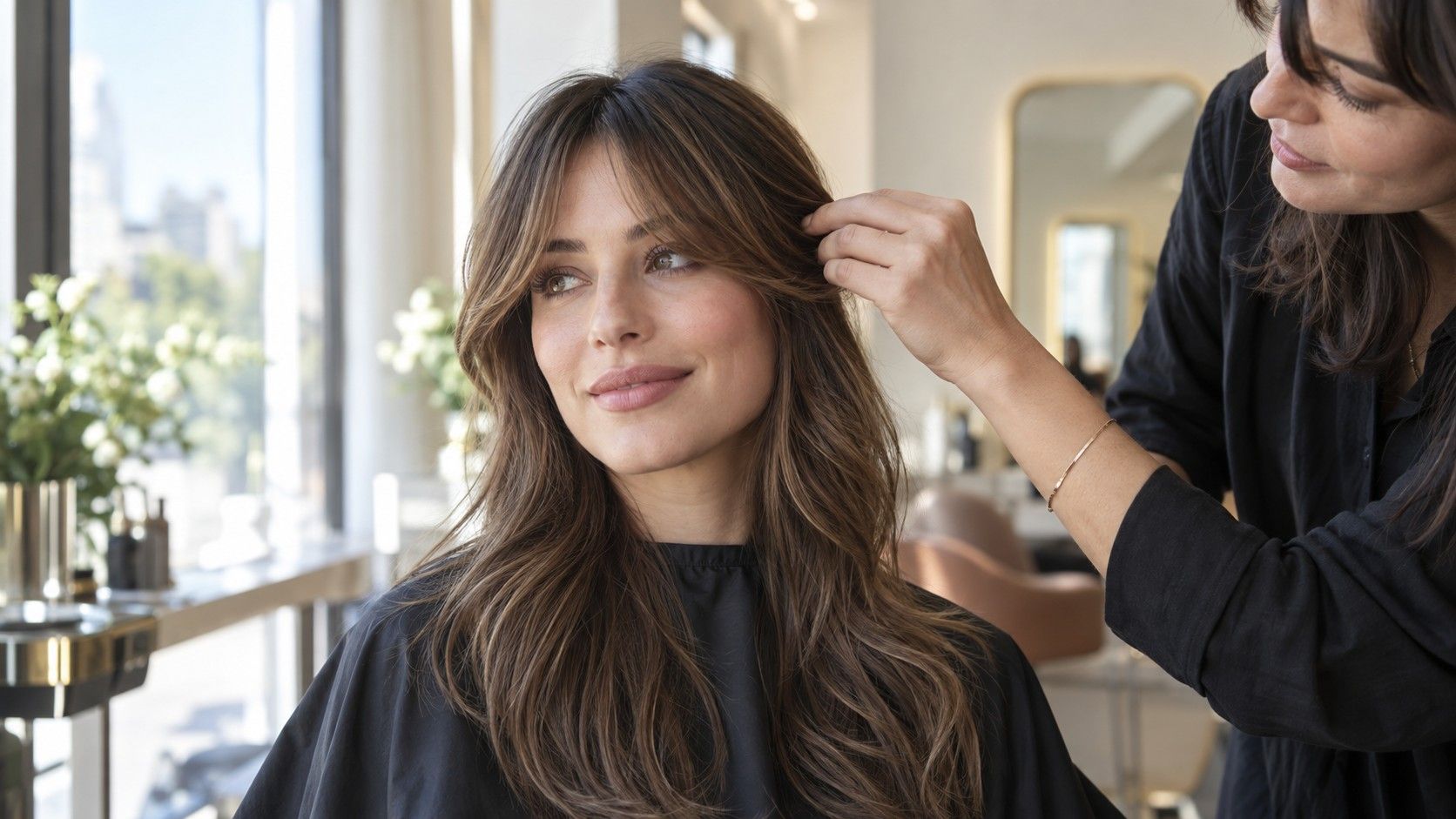
The best bangs for a large forehead are rarely about covering as much skin as possible. They are about deciding how much softness, movement, and daily effort you want around the hairline. A fringe can change the apparent proportion of the face, but it also introduces a small styling routine that is worth understanding before the first snip.
Choose coverage without hiding your face
Start by looking at the hairline, not only the forehead. If the hair grows evenly and lies forward easily, a light to medium fringe can give a soft frame without becoming a wall of hair. If the hairline has a pronounced peak, sparse corners, or a strong cowlick, the cut needs a little more flexibility. Trying to force a perfectly straight, dense edge onto hair that wants to split often creates more fuss than the fringe is meant to solve.
Coverage has degrees. Wispy bangs leave more of the forehead visible and are forgiving when they separate. A fuller fringe makes a stronger horizontal line and can be satisfying if you like a deliberate, graphic finish. Neither option is more correct. Think about whether you wear your hair up, whether you exercise, and whether you are comfortable pinning the fringe back on days when it is not cooperating.
Face framing matters as much as the centre section. Pieces that taper toward the cheekbones can keep a fringe from looking like a separate attachment. Ask to see the cut while the hair is dry and moving, not only when it has been combed flat and damp. That is the moment when the stylist can judge whether the corners need to be lighter or whether the fringe should sit a little farther back.
Curtain bangs and centre parts
Curtain bangs are a useful starting point for someone who wants bangs for a high forehead but is nervous about a full commitment. They open near the centre and sweep outward, so the forehead is softened rather than completely covered. Their best version is not automatically a centre part: a slightly off-centre opening can make the result feel less rigid and can work better with a natural growth pattern.
The important measurement is where the shortest point lands. A curtain fringe that begins too long may disappear into the rest of the haircut; one that begins too short can split and expose a line you were hoping to soften. Cheekbone length is a common reference, but it should be adjusted for glasses, curl, and how much the hair springs up once dry.
Curtain bangs are often described as low maintenance, which is only half true. They are easier to grow out than a blunt fringe, but they still need direction at the roots. A quick blast with a dryer and a small round brush is usually enough. Letting them air-dry with no shaping can leave the two sides pulling apart more widely than intended.
Full fringe and density
A full fringe can look polished when the hair has enough density at the front and the wearer likes a regular trim schedule. The line does not need to be heavy. In fact, a fringe that is dense only at the centre and slightly softer at the temples often feels more modern and is kinder to everyday movement. The goal is an intentional edge, not a helmet.
Density should be taken from an appropriate depth behind the hairline. Pulling too much hair forward can hollow out the sides of the haircut and make the fringe behave like a thick curtain. Pulling too little creates see-through sections that separate at the first sign of humidity. A stylist can test this by combing the proposed section forward before cutting and watching where it naturally divides.
Consider your glasses and makeup habits, too. A full fringe that rests on the lashes may be irritating with frames, while a slightly longer, textured edge can sit more comfortably. If you like a visible brow or use it as a feature in your makeup, ask for a fringe that skims rather than hides it. Tiny length changes make a large practical difference.
Cowlicks, texture, and the morning routine
A cowlick is not a reason to rule out bangs; it is a reason to cut them with the grain instead of against it. The most useful appointment detail is to arrive with your hair in its usual state. If the front has been straightened, flattened under a hat, or freshly blown out, the natural split may be hidden until the next morning.
Fine hair often benefits from a small amount of root direction and very little product. Heavy cream or oil can make a fringe stringy by lunchtime. Coarser or wavy hair may need a little more length so that the texture has room to settle. The same reference photo can therefore lead to different cutting choices, even when the forehead and face proportions are similar.
Keep the daily routine honest. Most fringes look best after thirty to ninety seconds with a dryer. Wet just the fringe, point the airflow downward, then move it side to side before letting it fall into place. This resets sleep creases without forcing you to wash and style the whole head every morning.
Trims, grow-out, and a salon consultation
Bangs grow into your eyes sooner than the rest of a haircut becomes noticeable. Many people are happiest with a small tidy-up every three to five weeks, especially with a blunt line. Ask whether your salon offers fringe trims and whether they prefer you to book them. Cutting at home can be tempting, but the first uneven correction often turns a small maintenance job into a redesign.
At the salon, say whether you want to soften the forehead, how you normally part your hair, how often you will blow-dry it, and whether you want a fringe that can be tucked away. Mention any cowlick before the cape goes on. Those details help more than declaring a fixed face-shape label.
For grow-out, the most forgiving path is usually to lengthen the centre gradually and blend the corners into face-framing layers. It will not vanish overnight, but it can become a deliberate shape rather than an awkward waiting period. Planning that exit route makes trying bangs feel less like a permanent gamble.